Feb - Apr 2025
Feb - Apr 2025
Metro Ticket Purchase
Metro Ticket Purchase
My Responsibilities
My Responsibilities
UX Research, UI Design, Prototyping, Evaluation, Stakeholder Management, Workshop Coordination
UX Research, UI Design, Prototyping, Evaluation, Stakeholder Management, Workshop Coordination
About the Company
About the Company
Digipay is a fintech company offering Iranian consumers Buy Now, Pay Later (BNPL) credit and bank loans for purchases on Digikala and partner merchants.
Digipay is a fintech company offering Iranian consumers Buy Now, Pay Later (BNPL) credit and bank loans for purchases on Digikala and partner merchants.
Overview
Overview
The business aimed to expand its existing services by adding a metro ticket purchase flow using monthly credit. The primary goal was to enable users to purchase tickets quickly and use them seamlessly, while encouraging active consumption of the granted credit balance.
I worked on this project as one of two Product Designers, collaborating closely to cover all phases, including discovery, competitive benchmarking, ideation, feasibility evaluation, usability testing, and end-to-end design execution.
The business aimed to expand its existing services by adding a metro ticket purchase flow using monthly credit. The primary goal was to enable users to purchase tickets quickly and use them seamlessly, while encouraging active consumption of the granted credit balance.
I worked on this project as one of two Product Designers, collaborating closely to cover all phases, including discovery, competitive benchmarking, ideation, feasibility evaluation, usability testing, and end-to-end design execution.
Research and Discovery
Discovery & Define
Research and Discovery
For the MVP phase, the business scope was limited to a metro ticket purchase feature. However, during discovery, we deliberately broadened the research lens to explore the end-to-end metro experience. This approach allowed us to identify gaps, unmet needs, and innovation opportunities beyond the initial scope, creating a foundation for potential future expansion of the feature.
For the MVP phase, the business scope was limited to a metro ticket purchase feature. However, during discovery, we deliberately broadened the research lens to explore the end-to-end metro experience. This approach allowed us to identify gaps, unmet needs, and innovation opportunities beyond the initial scope, creating a foundation for potential future expansion of the feature.
Questions to answer
Research Questions
Questions to answer
The research phase focused on answering the following key questions:
What issues, challenges, and concerns do people generally face when using the metro?
Who are the primary user groups of the metro?
How do people currently behave throughout the metro journey, and how do they make decisions along this process?
The research phase focused on answering the following key questions:
What issues, challenges, and concerns do people generally face when using the metro?
Who are the primary user groups of the metro?
How do people currently behave throughout the metro journey, and how do they make decisions along this process?
Desk Research
Desk Research
We reviewed academic articles from sources such as Iranian Anthropological Studies, Tehran Urban & Suburban Railway Company, etc., exploring the relationship between metro usage and the socio-economic conditions of users.
We reviewed academic articles from sources such as Iranian Anthropological Studies, Tehran Urban & Suburban Railway Company, etc., exploring the relationship between metro usage and the socio-economic conditions of users.
Key insights included:
Metro represents a high-frequency, high-volume touchpoint, making it a strategic channel for embedded financial services and micro-payments.
The low adoption of in-app metro payments (5%), despite widespread mobile payment usage، highlights a clear experience and value gap rather than a lack of user readiness.
For a significant portion of metro users, payment friction directly impacts daily expenses, positioning credit-based ticket purchases as a quality-of-life improvement rather than a convenience feature.
Given metro’s role as a dense public space, payment flows must be optimized for speed, clarity, and minimal cognitive load.
While affordability remains the primary driver of metro usage, a notable segment of users is willing to pay more for better service quality, indicating room for experience-led value creation.
Key insights included:
Metro represents a high-frequency, high-volume touchpoint, making it a strategic channel for embedded financial services and micro-payments.
The low adoption of in-app metro payments (5%), despite widespread mobile payment usage، highlights a clear experience and value gap rather than a lack of user readiness.
For a significant portion of metro users, payment friction directly impacts daily expenses, positioning credit-based ticket purchases as a quality-of-life improvement rather than a convenience feature.
Given metro’s role as a dense public space, payment flows must be optimized for speed, clarity, and minimal cognitive load.
While affordability remains the primary driver of metro usage, a notable segment of users is willing to pay more for better service quality, indicating room for experience-led value creation.
Competitive Benchmark
Competitive Benchmark
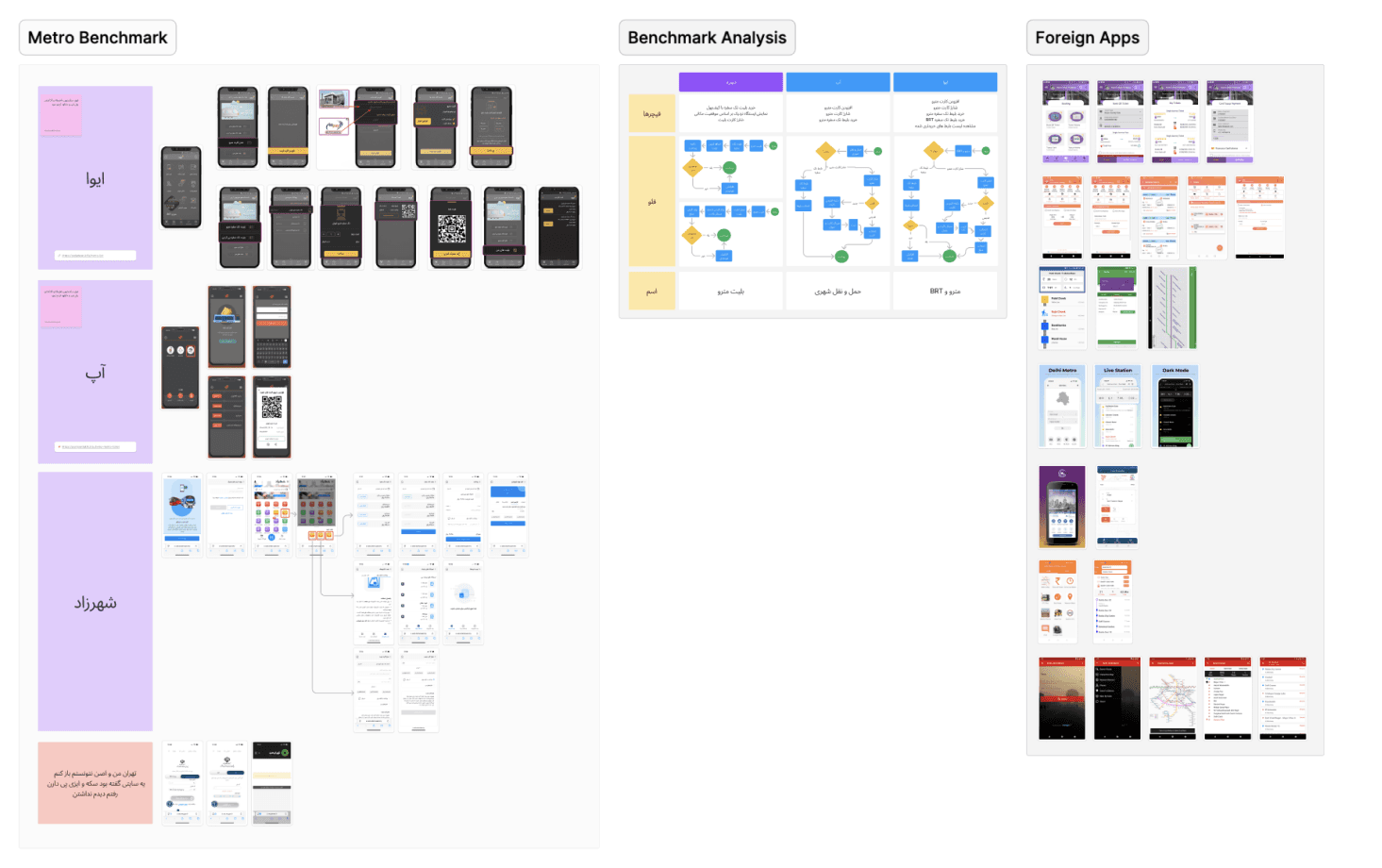
We reviewed the flows and key pages of several Iranian and international products, including Aap, Shahrzad, Iva, Delhi NCR, and Metro Ride Kolkata, to analyze metro ticket purchase and card recharge experiences. This review helped us understand existing product standards, identify market gaps, and derive actionable inspiration for our own solution.
We reviewed the flows and key pages of several Iranian and international products, including Aap, Shahrzad, Iva, Delhi NCR, and Metro Ride Kolkata, to analyze metro ticket purchase and card recharge experiences. This review helped us understand existing product standards, identify market gaps, and derive actionable inspiration for our own solution.
User Interview
User Interview
To gain a deeper understanding of metro users’ needs, challenges, and expectations around ticketing, I conducted 13 user interviews with a diverse group of participants, including both frequent commuters and occasional metro users.
The semi-structured interviews explored users’ current ticket purchase experiences, payment-related pain points, and unmet needs. In addition, I examined user experiences across the end-to-end metro journey, from the decision to use the metro, to arriving at the station and waiting times, to uncover broader opportunity areas beyond ticket purchasing alone.
The research also investigated user behaviors and preferences across different ticket types, including card-based, single-ride, and digital options, as well as the key barriers preventing adoption of digital ticketing solutions.
To gain a deeper understanding of metro users’ needs, challenges, and expectations around ticketing, I conducted 13 user interviews with a diverse group of participants, including both frequent commuters and occasional metro users.
The semi-structured interviews explored users’ current ticket purchase experiences, payment-related pain points, and unmet needs. In addition, I examined user experiences across the end-to-end metro journey, from the decision to use the metro, to arriving at the station and waiting times, to uncover broader opportunity areas beyond ticket purchasing alone.
The research also investigated user behaviors and preferences across different ticket types, including card-based, single-ride, and digital options, as well as the key barriers preventing adoption of digital ticketing solutions.
Data Analysis
Data Analysis
Affinity Mapping
Affinity Mapping
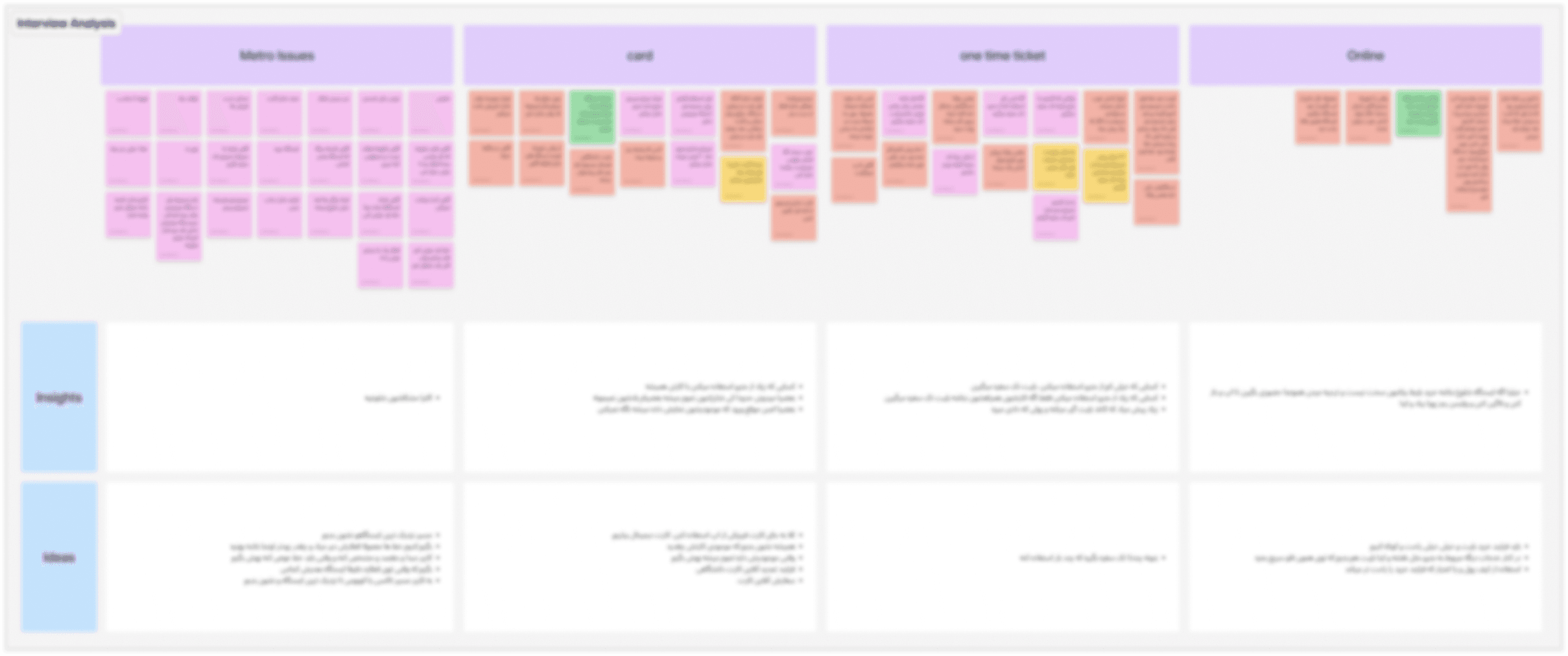
To analyze and synthesize the interview data and extract meaningful insights, I conducted an affinity-mapping exercise.
To analyze and synthesize the interview data and extract meaningful insights, I conducted an affinity-mapping exercise.
Key results
Key results
11/13 participants reported dissatisfaction with the lack of balance visibility on their metro cards, highlighting a critical transparency gap.
9/13 participants experienced confusion around which ticket type to purchase, indicating decision-making friction.
8/13 participants expressed a strong interest in purchasing metro tickets through mobile applications, signaling clear demand for digital ticketing.
8/13 participants reported encountering malfunctioning entry gates, which negatively impacted trust in the system and caused delays.
6/13 participants cited long queues and unclear processes for ticket purchase and recharge as major pain points.
5/13 participants expressed concern about boarding or exiting at the wrong station, or missing their intended stop, particularly during crowded or unfamiliar routes.
11/13 participants reported dissatisfaction with the lack of balance visibility on their metro cards, highlighting a critical transparency gap.
9/13 participants experienced confusion around which ticket type to purchase, indicating decision-making friction.
8/13 participants expressed a strong interest in purchasing metro tickets through mobile applications, signaling clear demand for digital ticketing.
8/13 participants reported encountering malfunctioning entry gates, which negatively impacted trust in the system and caused delays.
6/13 participants cited long queues and unclear processes for ticket purchase and recharge as major pain points.
5/13 participants expressed concern about boarding or exiting at the wrong station, or missing their intended stop, particularly during crowded or unfamiliar routes.
User Groups
User Groups
Analysis of the research findings also revealed two primary metro user groups.
The first group consists of frequent commuters who use the metro on a regular basis. These users typically own a metro card, are familiar with routes and stations, and only purchase single-ride tickets in exceptional situations, such as when they forget their card.
The second group includes occasional commuters who use the metro infrequently. These users generally do not own a metro card and rely on single-ride tickets when traveling by metro. In some cases, they purchase multiple single-ride tickets in advance to use later if needed. They also mostly face significantly more challenges, particularly in finding routes and stations, understanding ticket types, and deciding which ticket to purchase.
Analysis of the research findings also revealed two primary metro user groups.
The first group consists of frequent commuters who use the metro on a regular basis. These users typically own a metro card, are familiar with routes and stations, and only purchase single-ride tickets in exceptional situations, such as when they forget their card.
The second group includes occasional commuters who use the metro infrequently. These users generally do not own a metro card and rely on single-ride tickets when traveling by metro. In some cases, they purchase multiple single-ride tickets in advance to use later if needed. They also mostly face significantly more challenges, particularly in finding routes and stations, understanding ticket types, and deciding which ticket to purchase.
Experience Mapping
Experience Mapping
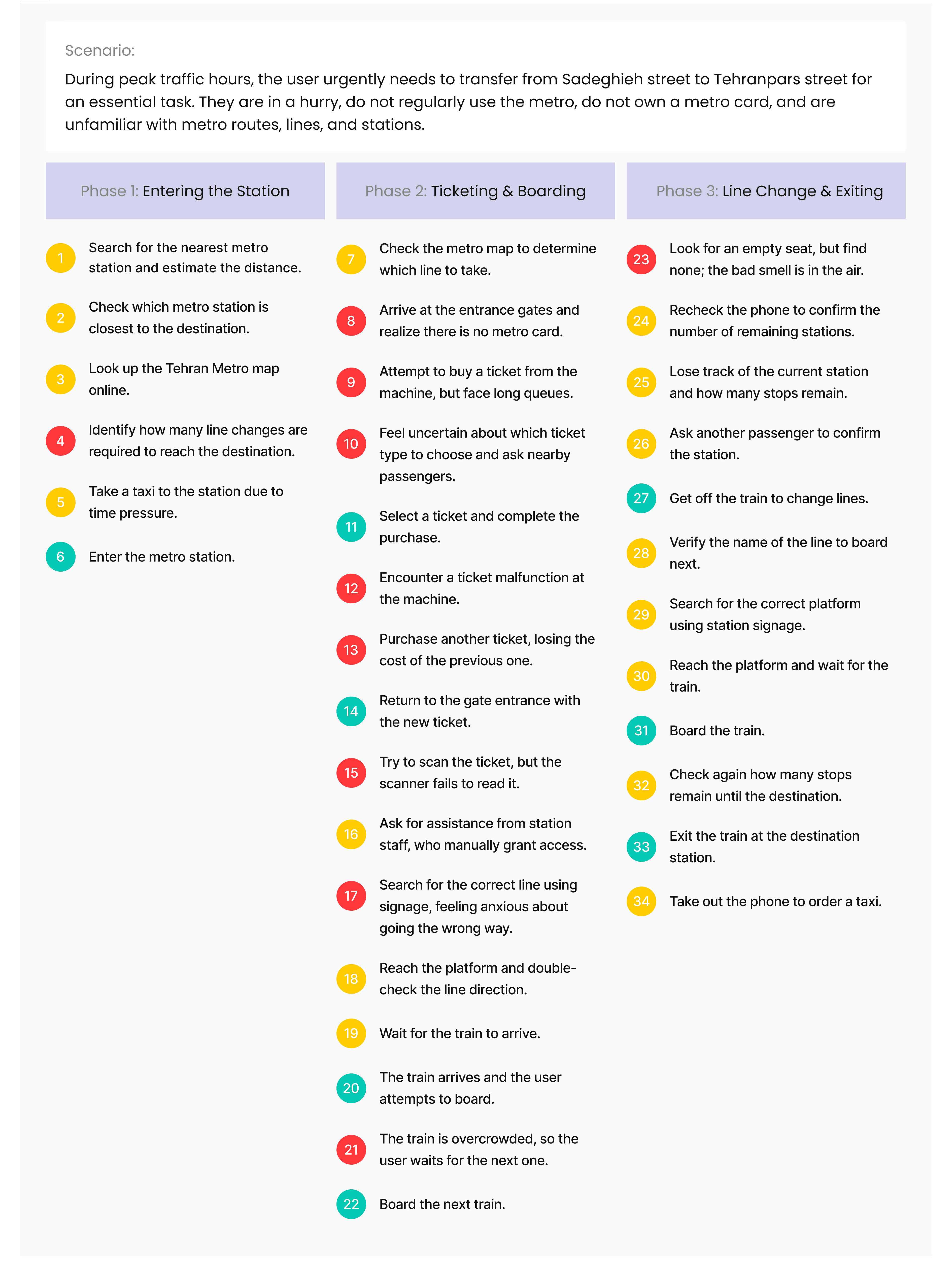
Given that the initial MVP scope was limited to single-ride ticket purchases, and that occasional commuters are the primary users of this feature, as well as the group experiencing the highest level of challenges, we focused our efforts on this user group’s experience. We mapped their end-to-end experience, analyzed their journey, and identified pain points at each stage based on insights derived from our research data.
Given that the initial MVP scope was limited to single-ride ticket purchases, and that occasional commuters are the primary users of this feature, as well as the group experiencing the highest level of challenges, we focused our efforts on this user group’s experience. We mapped their end-to-end experience, analyzed their journey, and identified pain points at each stage based on insights derived from our research data.
Design Challenge Definition
After developing a deep understanding of the user experience, we clearly defined our primary design challenge to guide the ideation and design phases and keep our efforts focused on a single, shared priority.
Design Challenge: "How might we enable metro users to purchase and use their tickets seamlessly and reliably, ensuring a fast, hassle-free, and trustworthy experience?"
Ideation & Design
Ideation & Design
Design Challenge Definition
Design Challenge Definition
After developing a deep understanding of the user experience, we clearly defined our primary design challenge to guide the ideation and design phases and keep our efforts focused on a single, shared priority.
Design Challenge: "How might we enable metro users to purchase and use their tickets seamlessly and reliably, ensuring a fast, hassle-free, and trustworthy experience?"
After developing a deep understanding of the user experience, we clearly defined our primary design challenge to guide the ideation and design phases and keep our efforts focused on a single, shared priority.
Design Challenge: "How might we enable metro users to purchase and use their tickets seamlessly and reliably, ensuring a fast, hassle-free, and trustworthy experience?"
Brainstorming
Brainstorming
We then moved into the ideation phase, generating concepts and exploring them through quick sketches. In a working session with the technical team, we reviewed and prioritized the ideas based on implementation effort to ensure the selected solutions were technically feasible within the MVP constraints.
We then moved into the ideation phase, generating concepts and exploring them through quick sketches. In a working session with the technical team, we reviewed and prioritized the ideas based on implementation effort to ensure the selected solutions were technically feasible within the MVP constraints.
Final Design
Final Design
Once the core concept and overall information architecture were defined, we moved into UI design and interactive prototyping. We then conducted usability testing with six users, covering the primary ticket purchase task as well as key secondary flows. Based on the findings, we iterated on the designs and finalized the solution for engineering handoff and implementation.
Once the core concept and overall information architecture were defined, we moved into UI design and interactive prototyping. We then conducted usability testing with six users, covering the primary ticket purchase task as well as key secondary flows. Based on the findings, we iterated on the designs and finalized the solution for engineering handoff and implementation.
Entry Point
Entry Point
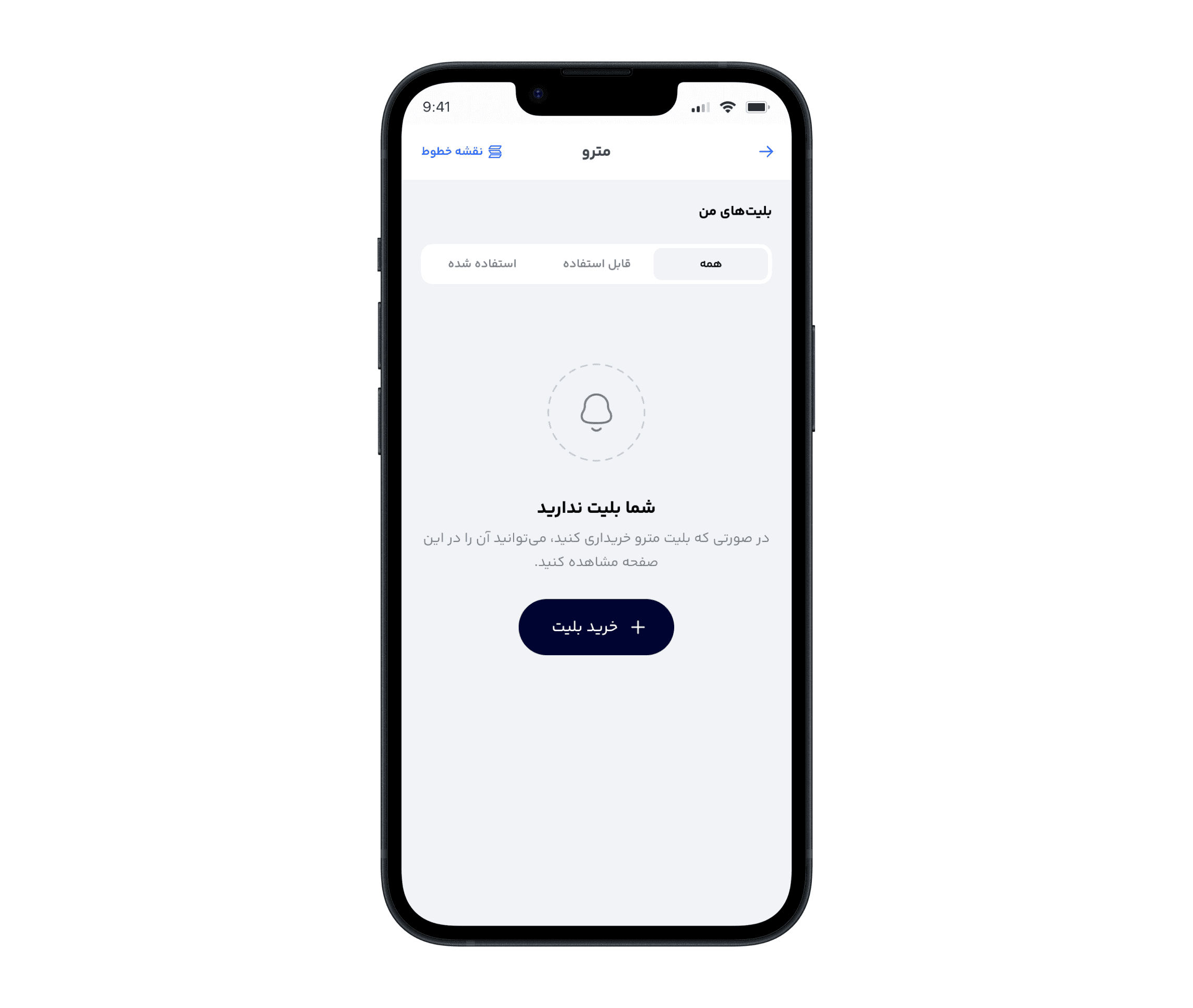
When users enter the Metro section in the DigiPay app for the first time, they are presented with an empty ticket list state. This intentionally communicates that no tickets are currently available and sets the correct expectation that a ticket must be purchased before usage.
A large, primary “Buy Ticket” call-to-action is placed at the center of the screen to immediately capture attention and guide users toward the next step with minimal cognitive effort.
When users enter the Metro section in the DigiPay app for the first time, they are presented with an empty ticket list state. This intentionally communicates that no tickets are currently available and sets the correct expectation that a ticket must be purchased before usage.
A large, primary “Buy Ticket” call-to-action is placed at the center of the screen to immediately capture attention and guide users toward the next step with minimal cognitive effort.
Tickets List
Tickets List
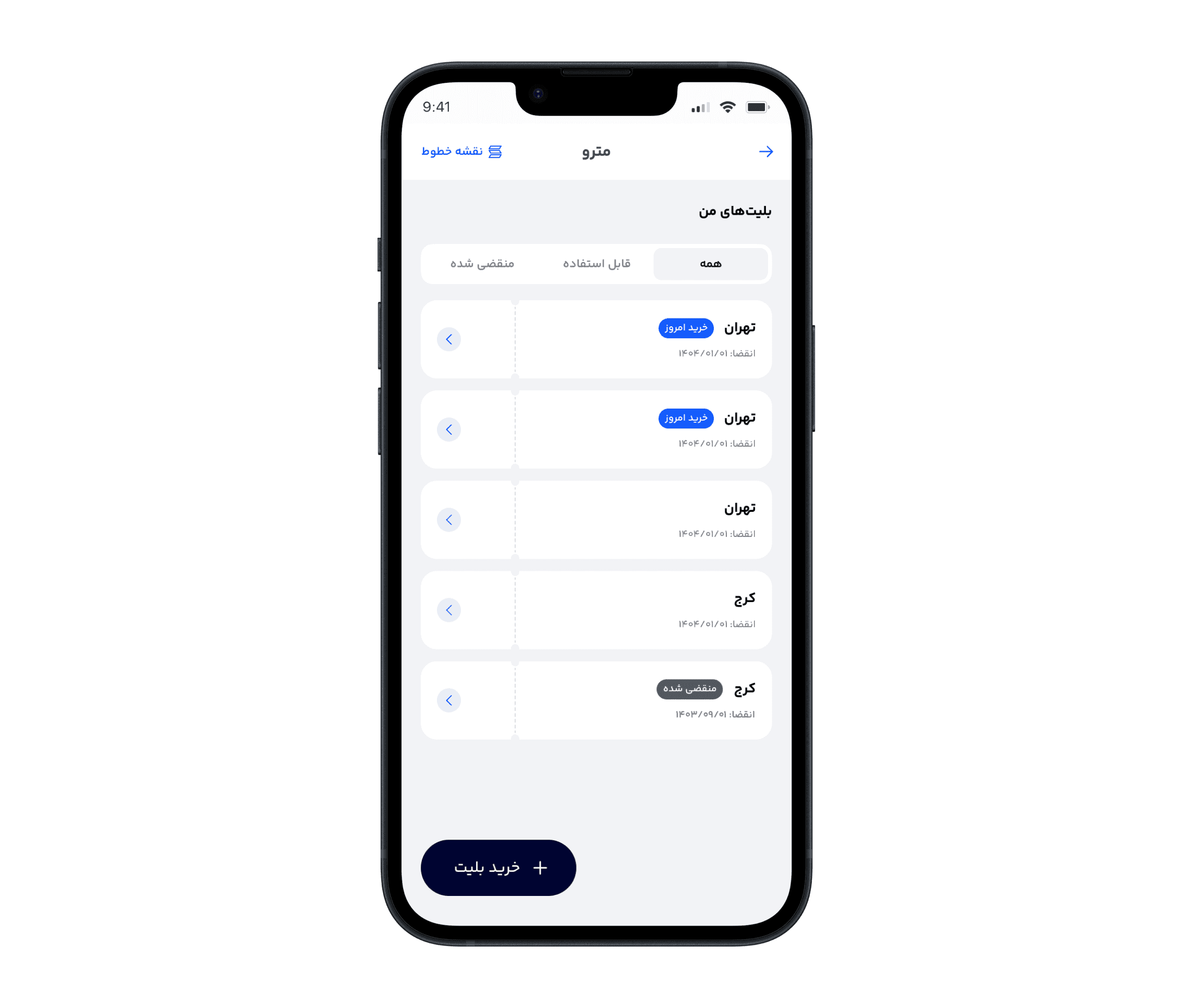
When users already have active tickets, the “Buy Ticket” call-to-action remains accessible as a floating button at the bottom of the screen. This ensures the primary action stays consistently available without disrupting ticket visibility, supporting quick repeat purchases and reducing navigation friction.
When users already have active tickets, the “Buy Ticket” call-to-action remains accessible as a floating button at the bottom of the screen. This ensures the primary action stays consistently available without disrupting ticket visibility, supporting quick repeat purchases and reducing navigation friction.
Ticket Buying
Ticket Buying
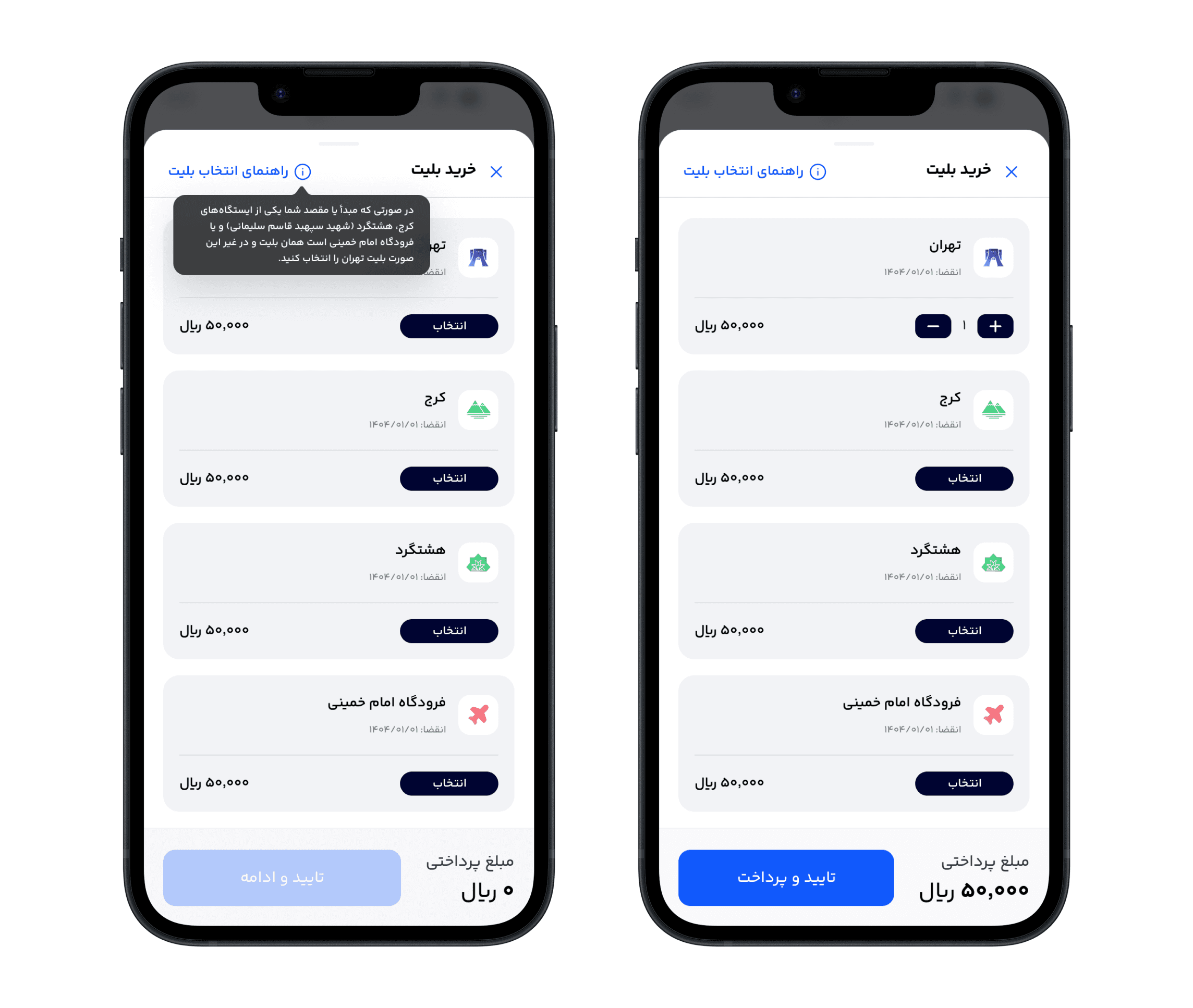
After users tap “Buy Ticket”, they see a list of the four available ticket types for Tehran Metro (since the service is initially limited to Tehran).
Each ticket type includes a distinct, memorable icon to support faster recognition and more intuitive repeat selection in future purchases.
The icon color of each ticket type matches the metro line color associated with that ticket, reinforcing users’ existing mental models.
A contextual help entry point (“Ticket Selection Guide” with an info icon) is placed at the top of the bottom-sheet to help users who are unsure which ticket type they should choose, without forcing them to leave the flow.
After users tap “Buy Ticket”, they see a list of the four available ticket types for Tehran Metro (since the service is initially limited to Tehran).
Each ticket type includes a distinct, memorable icon to support faster recognition and more intuitive repeat selection in future purchases.
The icon color of each ticket type matches the metro line color associated with that ticket, reinforcing users’ existing mental models.
A contextual help entry point (“Ticket Selection Guide” with an info icon) is placed at the top of the bottom-sheet to help users who are unsure which ticket type they should choose, without forcing them to leave the flow.
Purchased Ticket
Purchased Ticket
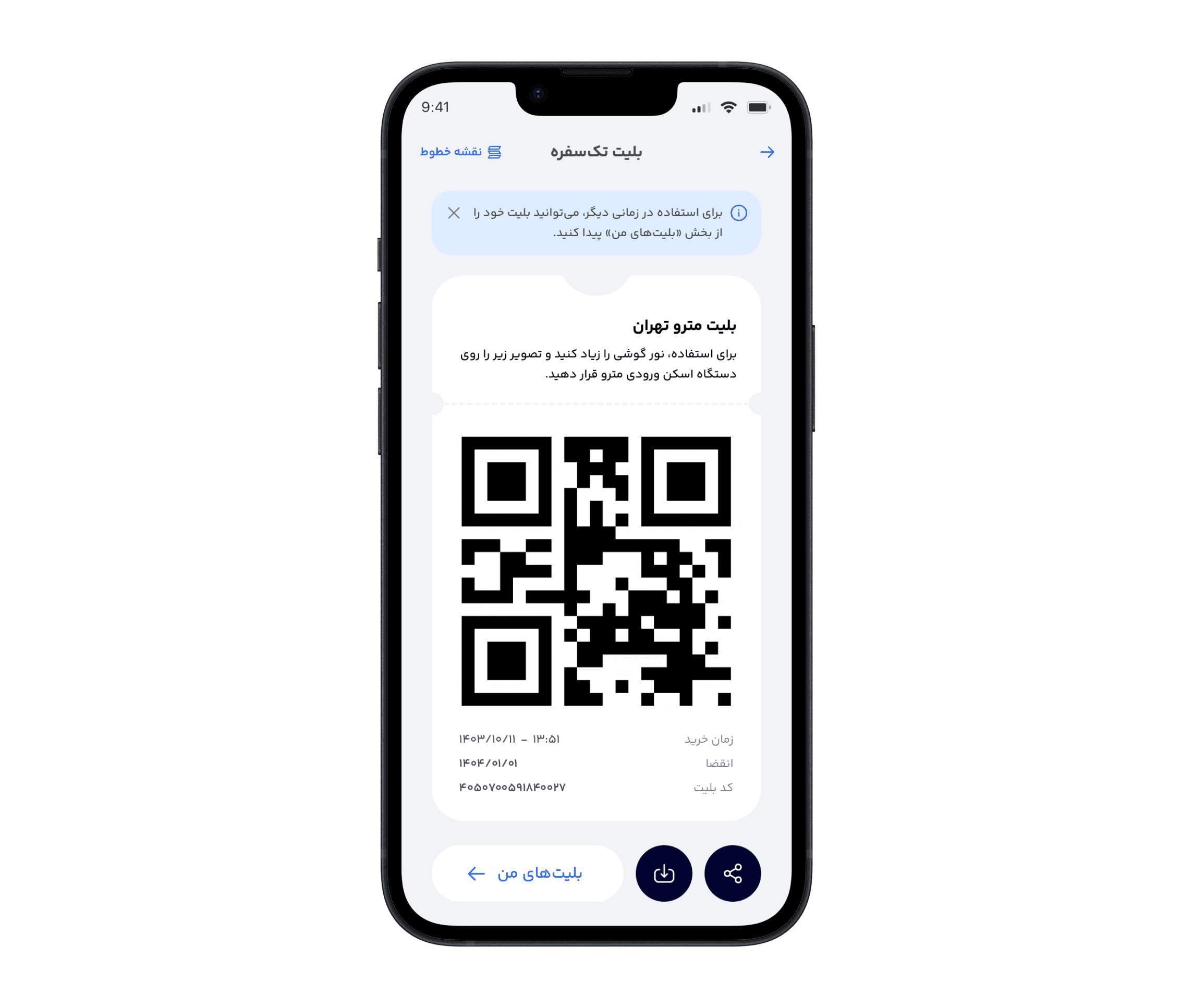
After purchasing a ticket, users are presented with a large, high-contrast QR code optimized for fast and reliable scanning at the metro gates.
A short inline instruction reminds users to increase screen brightness to prevent scanning failures.
Users can save the ticket QR code's picture to their phone, ensuring access even in low-connectivity station environments.
A clear message at the top of the screen reassures users that the ticket will remain available after closing the page, reducing anxiety and preventing unnecessary re-purchases.
After purchasing a ticket, users are presented with a large, high-contrast QR code optimized for fast and reliable scanning at the metro gates.
A short inline instruction reminds users to increase screen brightness to prevent scanning failures.
Users can save the ticket QR code's picture to their phone, ensuring access even in low-connectivity station environments.
A clear message at the top of the screen reassures users that the ticket will remain available after closing the page, reducing anxiety and preventing unnecessary re-purchases.
Metro Lines Map
Metro Lines Map
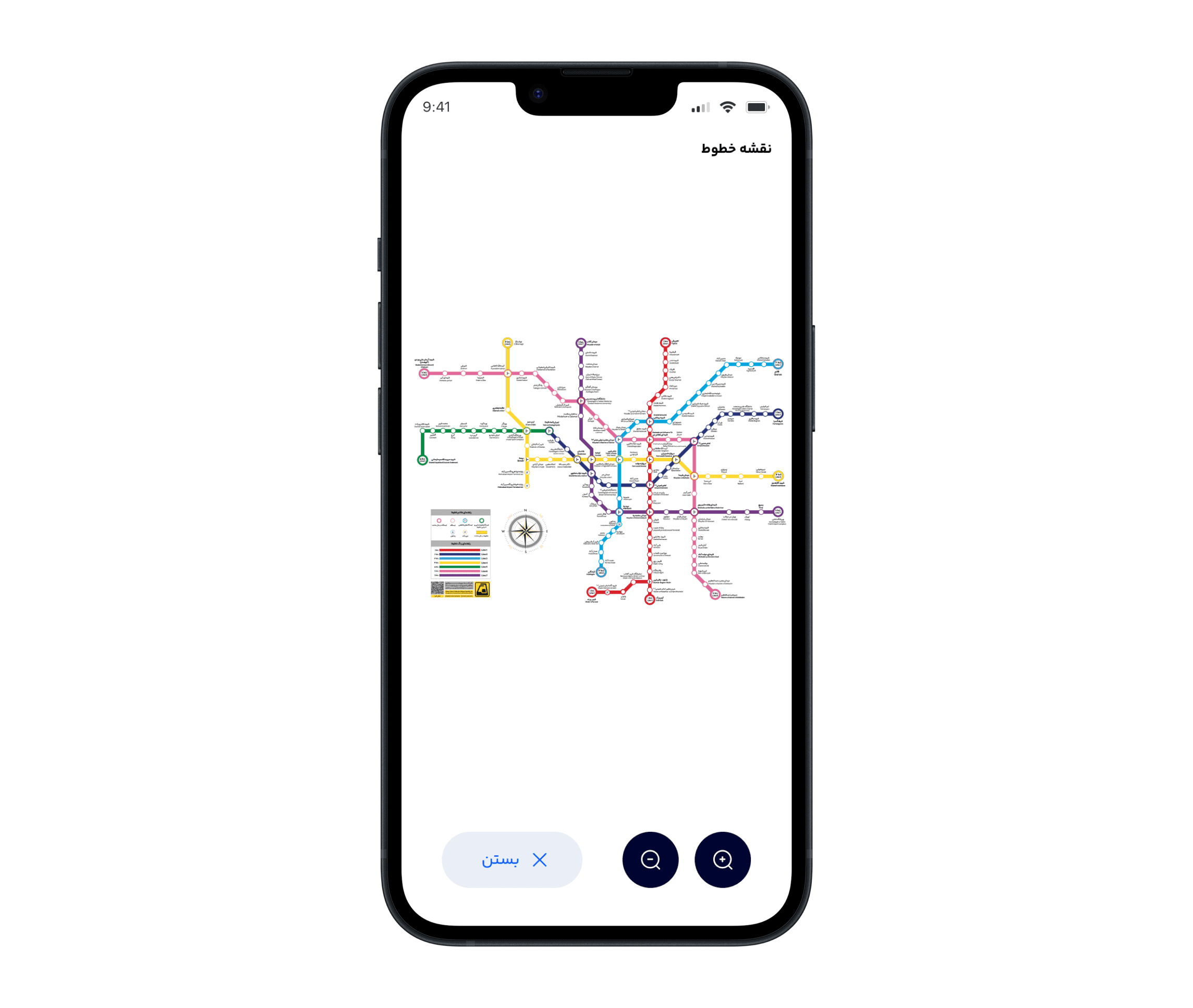
While advanced route planning was out of scope for the MVP, users can still access the Tehran Metro lines map via the “Metro Lines Map” entry point to help them find their route.
This option is available directly from the My Tickets main screen, ensuring quick access at the moment of need.
Users can also open the metro lines map after purchasing a ticket, via a top navigation action, supporting route confirmation without leaving the ticketing flow.
While advanced route planning was out of scope for the MVP, users can still access the Tehran Metro lines map via the “Metro Lines Map” entry point to help them find their route.
This option is available directly from the My Tickets main screen, ensuring quick access at the moment of need.
Users can also open the metro lines map after purchasing a ticket, via a top navigation action, supporting route confirmation without leaving the ticketing flow.